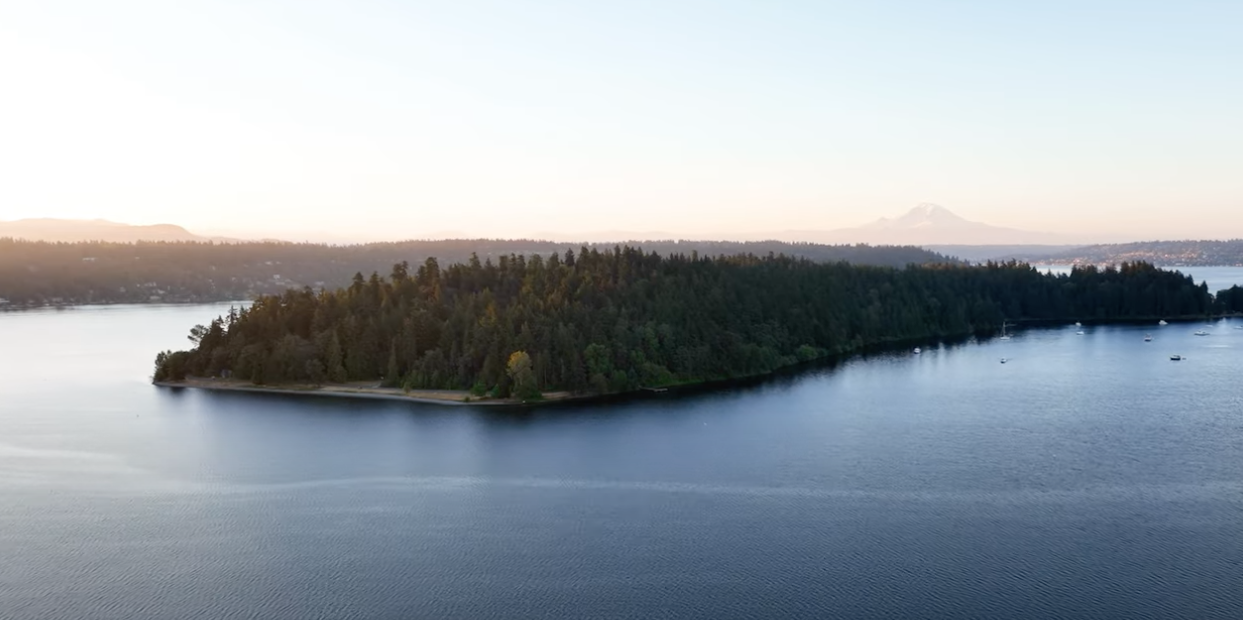
In a deeper sense, this forest is ten thousand years old, continuous at this site since the end of the last Ice Age. It dynamically regenerates after fire and other disturbances. Thousands of species of plants, animals and fungi live and evolve here together, some in competition, many in mutualistic collaboration.
Our goal? We want to see this forest flourish for at least the next 500 years.
The accelerating effects of the Anthropocene pose many threats. Novel pathogens have been introduced and aggressive invasive plants proliferate. Human overuse, pollution, abnormal precipitation patterns and rising temperatures play a role. These all threaten the health of this previously resilient forest.
We humans are the indirect - and sometimes direct - cause of these threats.
We can also be its protector. We can discourage overuse and restore bare ground. We can research and maybe sometimes mitigate and remedy disease effects. We can track its adaptations to climate change, understand the processes at work, manage with a light hand.
That changed 170 years ago. Within a hundred years, all but a thousand of those million acres were logged, cut down, and even mostly removed from memory.
But not at Seward. Here we see a classic lowland Douglas-Fir/Cedar/Hemlock PNW forest, large enough to be a functioning ecosystem. It grew up after a stand-replacement fire 500 years ago, then partly survived a less severe fire 200 years later. About a 100 mature doug firs, with thick bark, a few cedars, and (we conjecture) many sword ferns were among the survivors. The forest is an old and beautiful place. Many firs are 6 feet in diameter and more. The forest floor includes, and is sometimes dominated by, ancient individual sword ferns, each possibly a thousand years old, as has been suggested to us by fern botanist David Barrington.
Like the Douglas-Fir, sword ferns colonize open ground, rarely reproduce under a closed canopy, and live very long lives. As with the fir, endophytic protective fungi likely provide defense for the fern against rapidly evolving pathogens and herbivores, trading photosynthate for insecticides and other defences. Such mutualisms are apparently needed by all long-lived plant species.
These mutualisms, easily seen (as in nurse logs and flower pollination) or hidden from view (as with the endophytes) are part of the beauty of this forest.
But all is not well. Over the last decades, two crucial species - sword fern and western hemlock - have exhibited severe and regionally unprecedented mortality. In the last three years we see signs of reduced mortality rates in the ferns. The hemlocks do not yet provide any cause for optimism.
As citizen scientists we study the forest, monitor populations, run simple experiments, restore bare ground created by die-off and enthusiastic overuse by visitors and their dogs. Much of this is done on the cheap. Two generous donations of $5k and $8k have allowed more rigorous study. We receive excellnt support from Seattle Parks, especially in restoration planting and removal of invasive species.
Our study of the fern die-off has produced substantial evidence for a water-borne pathogen, and against drought and heat hypothesis. We have some interesting hemlock data. We have a scientific advisory board (SAB), described below .
These studies and work projects will continue. However, some of the research question require more money and skill than we volunteers can provide. We need your help: ideas, volunteer labor, and funding.
To that end, we have prepared a summary of our past projects, and suggestions - with cost estimates - for possible new projects, on new topics, but also and primarily, on the problems we have already identified.
Sword Fern Die-off: caused by a water-borne pathogen? The beer bottle experiment.
(Better video segment presentation coming soon. Click to start playing, click to stop.)
Not caused by drought: rigorous field work by Dylan Mendenhall.
(Better video segment presentation coming soon. Click to start playing, click to stop.)
Western Hemlock Decline
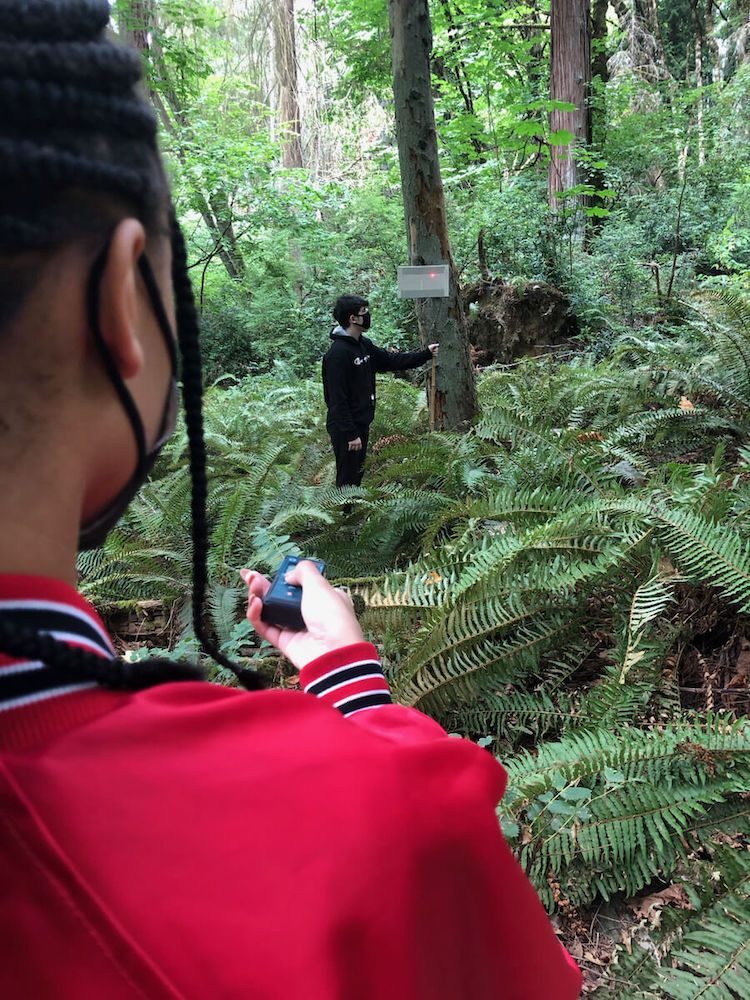
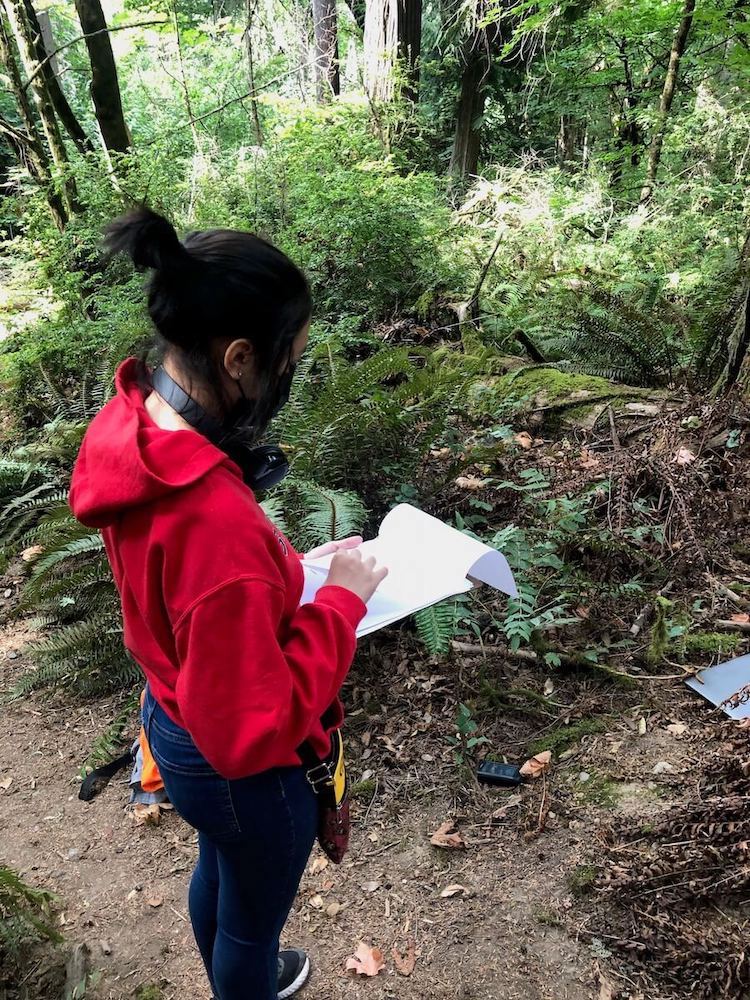
For two summers, we have conducted six week long summer research projects with student interns from Choose 180, a regional Seattle jail diversion non-profit, and UW students. In the first year, using a protocol provided by Drs. Marianne Elliott and Tim Billo, we assesed the health of 115 Western Hemlocks. The work was reported in the South Seattle Emerald.
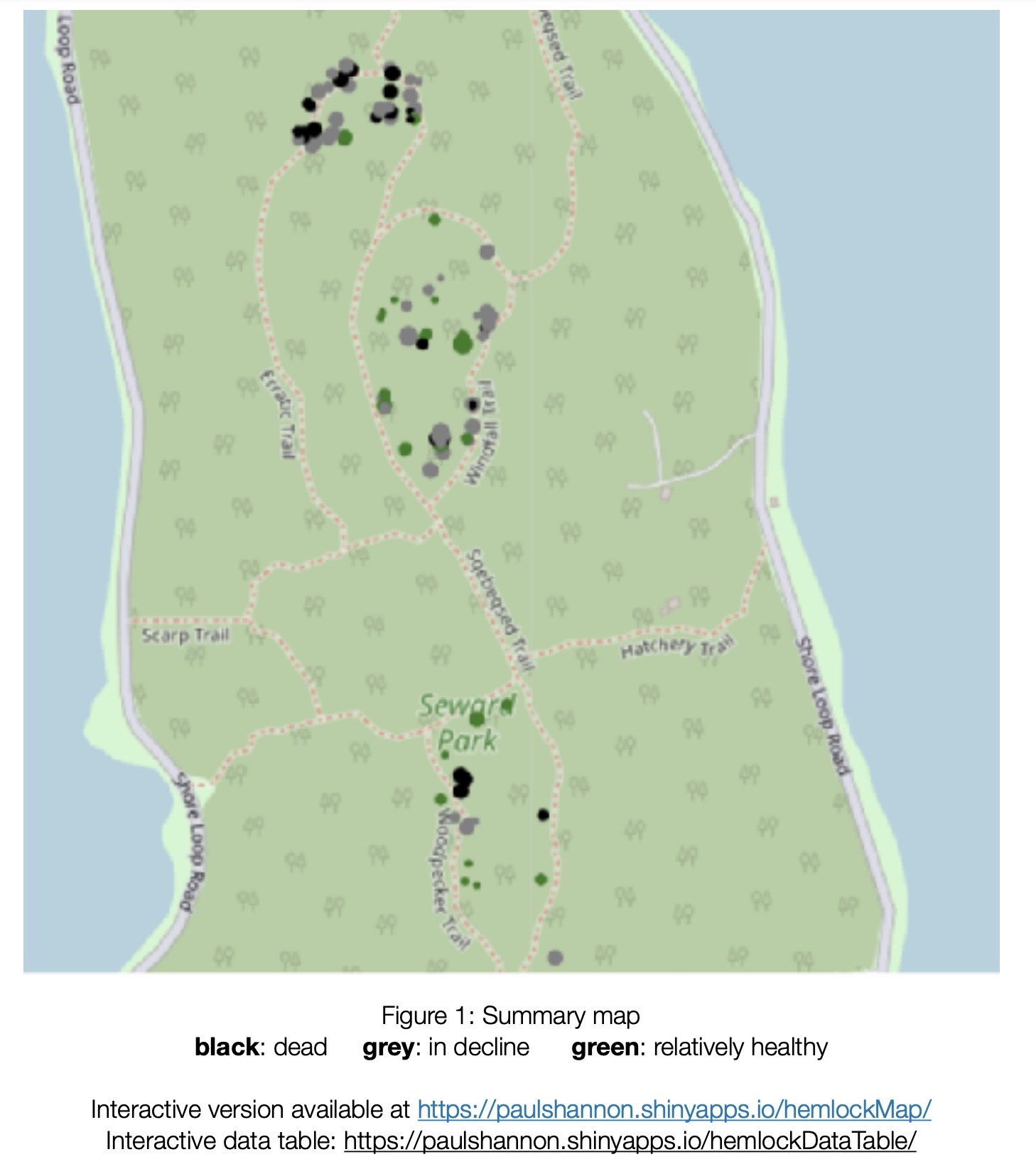
The final report is found here.
Evidence of Robust Douglas-Fir Health
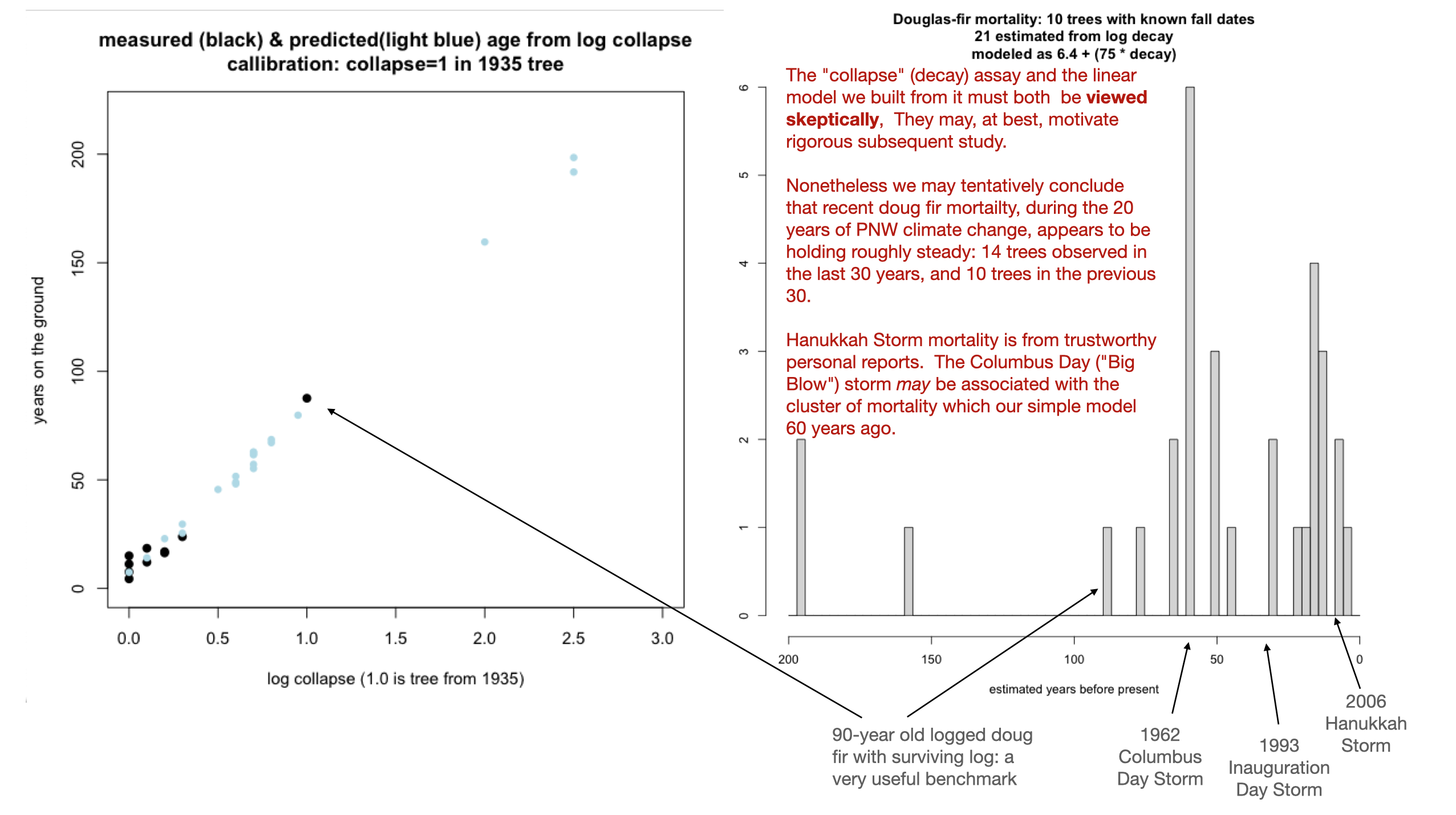
In the second summer of intern research, two students from the UW joined CHOOSE 180 interns to assess a century of Douglas-fir mortality. We tentatively concluded that Douglas-Fir health has held steady over the last 90 years:
We welcome other ideas. We solicit preliminary proposals especially, but not only, from scientists with experience in forest processes. For projects without institutional funding, we will do our best to raise funds.
We invite any prospective donors to conctact us. If you wish to support one of the projects listed here, or to suggest another project which could be pursued, we want to hear from you.
Sword Ferns: Veteran PNW Forest Ecologist Jerry Franklin (UW emeritus) emphasizes the need for research at Seward Park.
(Better video segment presentation coming soon. Click to start playing, click to stop.)
Sword Ferns: Test the water-borne pathogen transmission hypothesis using functicide & antbiotics
- Background: Along with Koch's postulates, this test is basic applied biochemistry. If the transmission effects disappear when the water has fungicide present, or antibiotic, then those broad classes of organisms (fungus or bacteria) are identified, simplifying subsequent work.
- Benefits: validate and refine, or reject, the pathogen hypothesis prior to subsequent deep sequencing
- Staffing: plant pathologist and assistant for three weeks
- Infrastructure: green house bench space, beakers, assays
Sword Ferns: Multi-dimensional analysis of an active die-off site vs control
- Background: this is not hypothesis-driven science, but exploratory, with multiple assays. We have two large active die-off sites in the center of the forest, each with steady progression of effect and mortality, some 20% survival, and with healthy ferns nearby: well-posed "natural experiments".
- Benefits: new hypotheses may arise, possibly indicating complex causality
- Staffing: soil, insect, ecosystem and plant pathology scientists, working collaboratively, for 3 months
- Infrastructure: a mix of field and lab work across several disciplines
Western Hemlock: Multi-dimensional analysis of mortaility
- Background: The fungus Rhizoctonia butinii is reported by OSU's LeBouldus Lab to cause needle loss like what we see. Is it indeed present at Seward? We have been unable to locate any followup studies, nor any research into the mechanisms of Hemlock Decline. A few trees of different ages are as yet unaffected. Why? Would watering selected trees during drought reduce its compounding effects, contribute to tree survival? Note that we saw widespread Hemlock decline was observed a decade before the dramatic heat of 2015.
- Benefits: R. butinii could be confirmed, disproven, or found to be but one of multiple agents.
- Staffing: plant pathologist, two weeks
- Infrastructure: field collection tools, laboratory culture, perhaps PCR or DNA-sequencing
Forest Health: Ongoing dead/bare ground restoration projects
- Background: areas of dead and bare ground appear regularly in the forest, due to off-trail human and canine trampling, or to sword fern die-off. These small sites are ecological deserts. Their proliferation weakens the forest as a whole, creating the possibility for further declines. Natural regeneration is very slow beneath a closed canopy, so human assistance is worthwile. Our recent three-fold strategy shows promise, but needs long-term assessment and refinement: use only hardy native plant species, deep mulching a year in advance of planting, with subsequent monitoring of plant & soil health.
- Benefits: long-term integrity of the forest
- Staffing: volunteer groups to move mulch and plant, Seattle Parks/Green Seattle Partnership for mulch and plants, follow-up monitoring for five years, observational reports of survival (1 citizen scientist at quarterly intervals) recurring lab and technician studies, also at quarterly intervals
- Infrastructure: inexpensive remote soil moisture sensors, environmental sequencing to determine relationships between soil biome and plant health.
Forest Health: Census, proxied by assessing tree mortality, and that of other plants, at regular intervals.
- Background: long-term forest monitoring is crucial to understanding and responding to forest problems. A lot of this work can be done by volunteers, managed by trained naturalists.
- Benefits: Long-term forest health depends upon long-term forest monitoring.
- Staffing: lay scientist or naturalist with good knowledge of the forest, data acquisition and analysis skills, part-time episodic work, into the far future. Currently - but not sustainably - we staff this with volunteers.
- Infrastructure: ongoing modest salary support, volunteer engagement, long-term data storage. With increased staffing and training, far more complete forest health monitoring can be accomplished.
Forest Health: A comparison with two other nearby mature urban forests
- Background Last year we found minor sword fern die-off at St. Edward's State Park, and minor Hemlock decline in West Seattle's Schmitz Preserve. Perhaps herein we have a natural experiment, providing insight into disease processes by close study and comparison of the attributes and health status of these three forests.
- Benefits: Uncertain.
- Staffing: Uncertain
- Infrastructure: Uncertaion
Forest Health: A century of decline due to water table loss?
- Background In 1916 Lake Washington was lowered nine feet. An equivalent drop to the water table beneath the Seward Park peninusula is likely. Two Seattle area urban mature forests have much less loss of ferns and hemlocks, and both of these have year-round streams; Seward has only a few small seasonal streams. Perhaps this possible long duration loss of available water in the forest has contributed to its higher susceptibility to disease.
- Benefits: Uncertain.
- Staffing: Uncertain
- Infrastructure: Uncertaion
- Note: Some have conjectured that water deficits may also result from the paved road that circles the Seward Peninsula: the interuption of historically continuous vegetation from lake to forest interior may have had consequences.
To achieve this level of scrutiny, we have convened a panel of scientists and naturalists, each familiar with the forest at Seward Park. The Friends of Seward Park will support this group so that me make very efficient use of their time and expertise.
SAB Members
- Tim Billo, PhD, Ecologist, UW College of the Environment
- Elizabeth Van Volkenburgh, PhD, Plant Physiologist, UW Biology Professor Emerita
- Paul Talbert, PhD, Molecular Biologist, Fred Hutchison Cancer Center.
- Ed Dominguez, Lead Naturalist, Seward Park Audubon Center
- Mark Boyar, Mountains to Sound Greenway Trust board member; President, Middle Fork Outdoor Recreation Coalition
- (A few other members are likely, pending confirmation)